Designing Learning Within Fixed Constraints
In many organizations, the format of a learning experience is locked before an instructional designer even begins content development. An organization may need to maintain consistency within its catalogue by offering the same three course formats. There may be constraints based on how the business is set up; some instructional designers may work exclusively on eLearning, while others work on live training. And other times, there are constraints around resources. Perhaps a video course would be most engaging, but the organization doesn’t have video production resources. Instructional designers need to navigate these constraints, making choices around scope, engagement techniques, practice and examples, transfer support, and assessments.
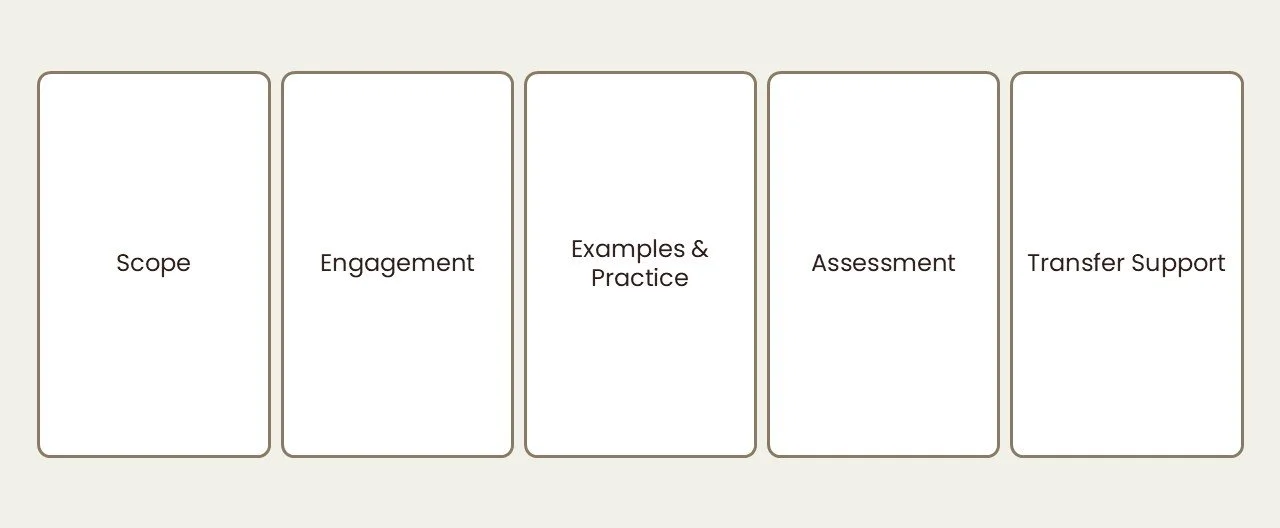
Scope: Scope is one of the most important things instructional designers can control when other factors are fixed. My goal is to determine the fundamental knowledge and skills a learner needs to perform a task better and how to build them, given predetermined constraints. This involves working closely with subject matter experts to distill content to its most essential elements and make difficult trade-offs to prioritize application.
Engagement: As a classroom teacher, I quickly learned that just because a learner appears engaged (eyes on the board, taking notes in a notebook) doesn’t mean they are engaged. In eLearning, interactivity is often touted as an essential engagement technique — and it can be! But clicking doesn’t necessarily correspond with cognitive engagement, and it can sometimes undermine it. As an instructional designer, I integrate interactivity with intentionality, prioritizing interactions where learners need to build mental models, whether that’s organizing the information, chunking, showing relationships, or illustrating a process. Early in my design work, I was struck by the range of interactions authoring software makes possible. Ultimately, low-tech engagement techniques like reflection prompts or mental rehearsal are often more impactful than complex interactions.
Examples and Practice: Regardless of the format, over-emphasizing content can leave learners with a lot of information but no clear understanding of how to apply it. I often design learning around a process or framework because it provides a clear, repeatable starting point. Memorizing a process is rarely the learning objective — it’s where learning begins. Next, examples and scenarios build discernment around decision-making when a task requires making judgment calls. After digesting a variety of examples, learners need a safe space to apply what they’ve learned. The number of examples and the amount of practice needed vary based on learners’ existing expertise, nuances surrounding the job task, and variability within the work environment.
Assessment: When the learning goal is to improve performance, assessments should focus on decision-making rather than recall. Learning formats can pose real constraints for assessments and feedback. Regardless of the format, I prioritize lightweight checks for understanding that help the learner self-monitor, along with assessment questions that focus on application.
Transfer support: All of my courses — whether 5 or 90 minutes long — include a leave-behind that can include a tool, job aid, visual, or summary of the key learning. The most effective transfer supports are often simple and maintainable since they need to live beyond the learning experience. These are what the learners will refer to after the course ends.
Every instructional designer needs to be able to adapt to constraints. However, there are times when instructional designers need to push back. When design choices are detrimental to learning or decision-making undermines credibility, I use my role as an opportunity to advocate for the learner by presenting research-based alternatives. However, in many cases, I use nuance and judgment to affect scope, engagement, examples, practice, assessment, and learning transfer to deliver effective learning even when the format is predetermined.