
Writing Compliant, Actionable IEP Goals
Tools: Articulate Rise & Storyline, Miro, HeyGen
Overview
For special education teachers, writing Individualized Education Program (IEP) goals is a routine part of preparing for an annual review meeting. While it is a compliance task, the purpose of the IEP goal is to provide a roadmap for teachers, service providers, and parents to support a student with disabilities. As a special education teacher, I read many IEP goals that technically satisfied compliance requirements but were difficult to interpret or act on – to the detriment of student progress and parent engagement.
This project started with a question: what does it take for a special education teacher to write a goal that satisfies legal requirements and is genuinely useful? The result is a VILT session designed for experienced special education teachers, accompanied by a spaced-retrieval microlearning delivered three to five days after the session. The training focuses on tracing a goal directly to a student's present level of performance in a way that all teachers, service providers, and parents can understand and act on.
Analyze
Before designing, I conducted interviews with two subject matter experts (SMEs): an occupational therapist and an ICT special education teacher. Though they engage with the same IEP process, they do so in different capacities and settings. My experience as a former special education teacher also gave me a foundation for evaluating their responses and surfacing patterns their interviews didn't.
I wanted to understand what makes a bad goal and the conditions that tend to produce them.
Goals are often written months before the annual review, so students may have already mastered the target skill by the time the goal is formalized.
Goals sometimes target skills two or three steps beyond the student's current level, so they are not immediately actionable.
Goals often bundle multiple skills into a single objective, making it hard to measure progress accurately.
Both SMEs also identified two common parent reactions. Some families hyperfocus on goals, while others dismiss them as a formality. The root cause of both reactions is the same: the goals failed to clearly communicate the student's next steps and how they relate to their current performance.
The interviews made clear that these patterns have different root causes. The first is a workflow and timing issue. The second and third are more directly skill-based. Writing a goal that links back to a student's present level of performance (PLOP) is a skill that improves with training. So is writing criteria specific and discrete enough for two different people to measure consistently are skills that improve with training. Therefore, the training focuses on these two patterns and doesn’t attempt to solve the workflow or timing issues.
Design
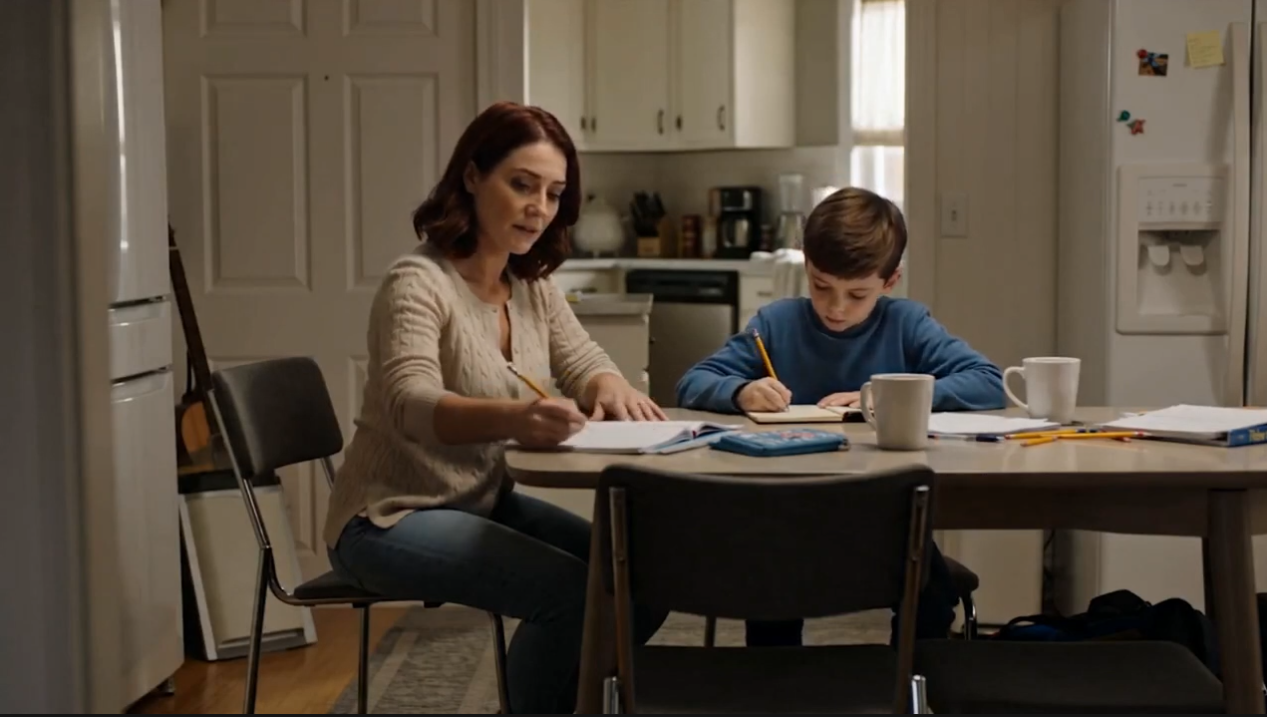
Having worked as a teacher for years, I knew that the central design challenge was to motivate teachers with an entry point that felt relatable and human. The solution was to open with a parent perspective video, which I scripted as a parent's reflection on sitting through an IEP meeting she could not follow. The script was based on a real family experience and kept deliberately universal.
I originally tried to find a real parent account from YouTube because I thought a first-person narrative would have the most impact. Since I couldn't find anything that showed parents reflecting on an actual IEP meeting, I decided to develop a video in Vyond. When I finished the first draft of the video in Vyond, I realized that the cartoon imagery diminished the video’s emotional impact. I wanted a photorealistic video but couldn't find enough B-roll to tell a continuous narrative, so I pivoted to HeyGen.
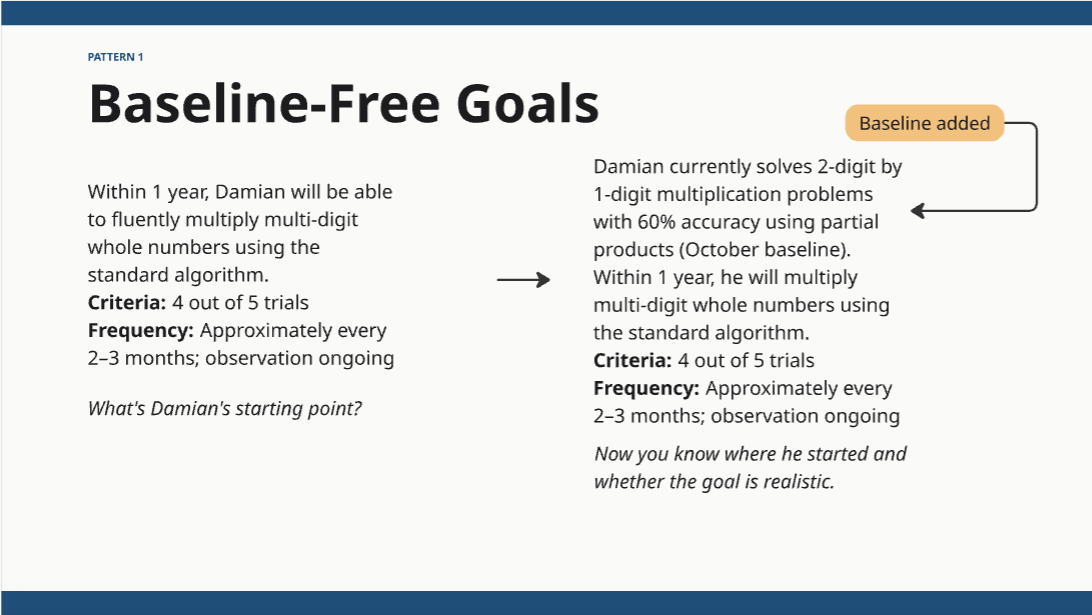
After the video hook, the session teaches three diagnostic lenses. Each pattern is introduced through a before/after example using the same student's goal, revised incrementally across three slides. I originally tried presenting the revision as one clean before/after, but chose to model and explain each revision individually since learners likely won't see all three patterns in their own work. Ultimately, I decided to show each fix in isolation, so teachers can see exactly which decisions were made and why. That sequence also sets up the guided practice and the microlearning that follows.
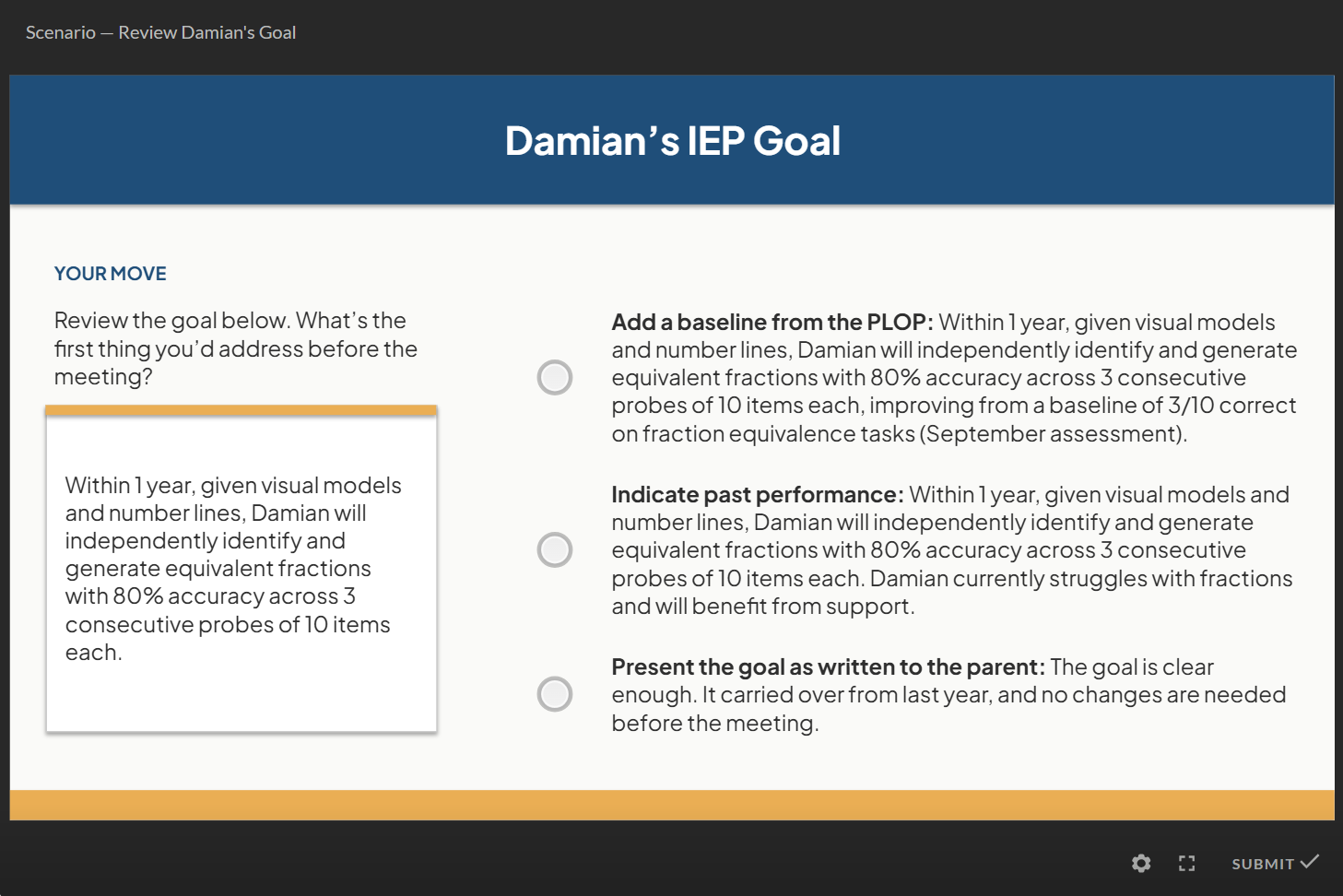
For the spaced-retrieval microlearning, I decided to include branching scenarios because I wanted learners to practice real-world decision-making. The three scenarios are sequenced to fade support over time. Scenario one gives learners answer choices, feedback, and a chance to retry if they get it wrong. By scenario two, there are answer choices and feedback, but no retry. The third scenario isn't multiple choice. Learners write an open-response revision and compare it against an exemplar to self-evaluate. By the end of the microlearning, they're producing and judging their own work.
Develop
Deliverables for this project include:
A Miro board designed as an interactive facilitation workspace
A facilitator guide with slide-by-slide facilitation notes, designed so that any trained facilitator could run the session consistently
A short HeyGen video used as the opening hook
A Rise spaced-retrieval microlearning with branching Storyline scenarios presenting three realistic goal-writing decisions and consequence-based feedback
All deliverables were built with accessibility in mind, including closed captions, alt text, intentional focus order, and WCAG 2.1 AA contrast standards throughout.
Of these four deliverables, the HeyGen video took the most iteration because it was difficult to generate footage that maintained continuity in characters across shots. Through this process, I ultimately used reference images and developed a specific prompt structure that allowed for continuity.
Results
This project changed how I think about compliance training. Teachers don’t have to choose between goals that meet legal criteria and goals that are genuinely useful — an IEP goal can, and should, do both. That's what this training is designed to show. The parent video is integral to that shift in framing because it makes the consequences of unclear goals tangible and personal. The lesson that I'll carry forward from this project is that when a compliance task has real human consequences downstream, my job is to make those consequences visible.